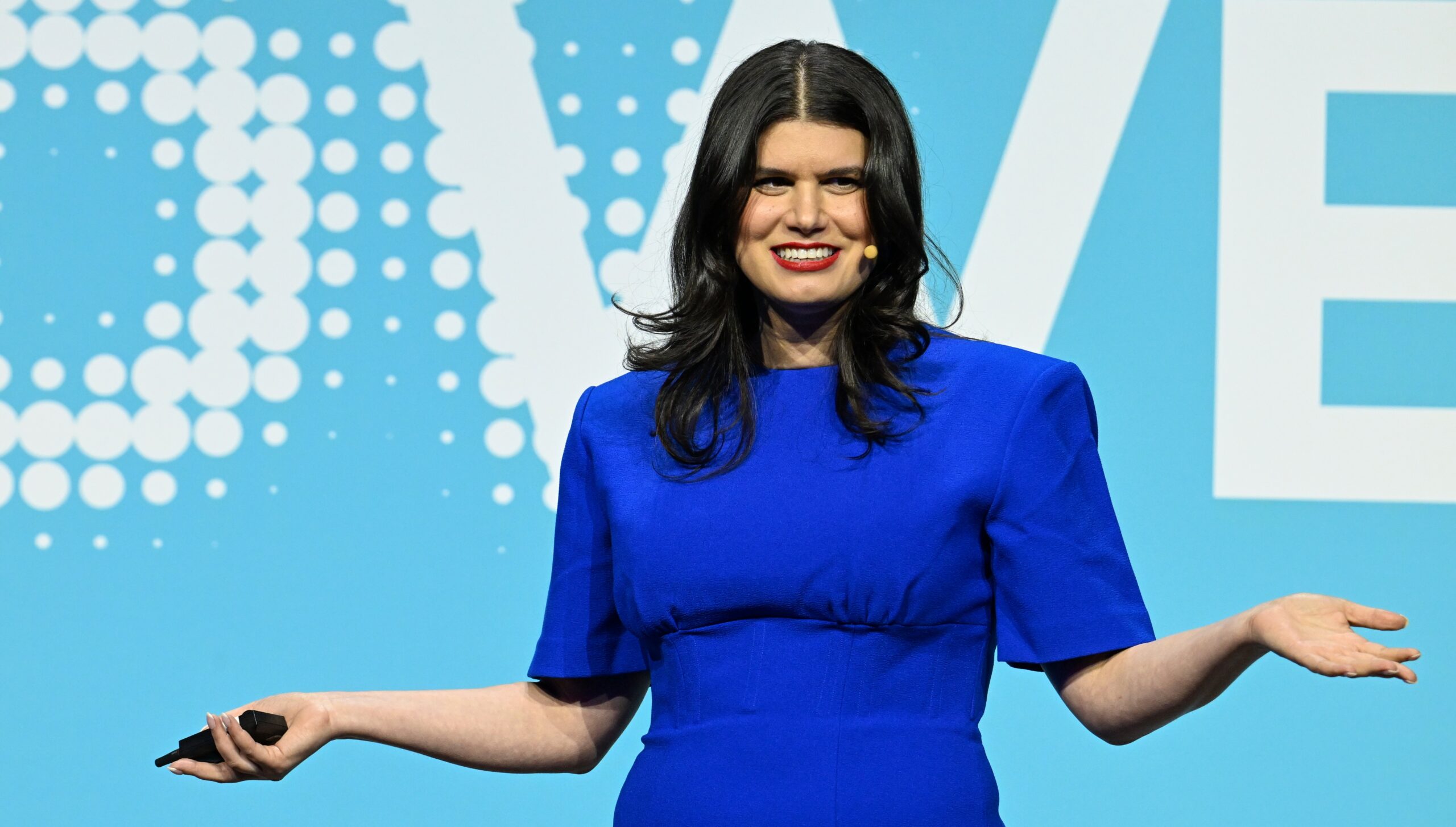
After psychiatrist Sasha Hamdani lost her father, grief didn’t just break her heart—it broke her carefully constructed systems for functioning with ADHD. What she discovered changed everything: neurodivergent brains don’t grieve “wrong,” they grieve differently. Sometimes that means creative explosions at 3 AM. Sometimes it means needing three times longer to find solid ground. Always, it means we need new frameworks for understanding how loss moves through different minds.
Watch next
When Grief Collides with a Neurodivergent Brain
2025 ⸱
Sasha Hamdani, MD
Share
About the speaker(s)
Dr. Sasha Hamdani is a board-certified psychiatrist and ADHD clinical expert. She is an author, entrepreneur, and mental health advocate. Dr. Hamdani has worked closely with the White House and Surgeon General’s team to speak out about mental health awareness and was recognized by Harvard as a public health leader. She also has a robust social media following on Instagram, TikTok, and YouTube (@thepsychdoctormd) where she provides evidence-backed information and dispels stigma around all facets of wellness. Her book Self-Care for People with ADHD was released through Simon and Schuster in 2023 and her comprehensive ADHD management app FocusGenie launched in Fall of 2023.
Transcript
When I was in medical school, I hit a wall. The topic was nephrology. So the study of kidneys, and I’ll be totally honest with you, I don’t care about kidneys. I just like, I don’t like them. They’re unnecessarily complicated. There’s too much physiology. There’s too much chemistry. I don’t want to, I don’t want to follow a sodium ion through a nephron.
I don’t care. And I have a adhd. It’s just like not for me, my mom. Is a physician and her brilliant advice to me at that time was just memorize it. It’s like, that doesn’t help me. My dad, who was an engineer, actually did help me. He came into my room one night and I was crying and I had all these books around me and he like disappears for a little while and then he comes back and he has these like whiteboard sheets underneath his arm and he like.
Minority report style, just like plasters them all over my room and start, we started sketching out the kidney and my dad wasn’t in medicine. He didn’t know all the medical terms, but he understood flow. He understood that if you could visualize the logic, you could master that chaos. And so we sat there and he would, he would draw arrows and he would show me where that sodium went.
And then, uh, you know, eventually. Eventually I got it, and that’s what my dad did. He took complicated things and made them organized. He took things that were overwhelming and molded them into something that I could hold onto, and it wasn’t just with kidneys. He did that with everything in my life. He was this quiet structure that held up everything else for me.
He was the biggest. Part of my life. He’s the reason I became a doctor and he is the reason I’m on this stage. He gulping, he passed away last April. Um, and when I say that my brain broke, I, I can’t, I, I can’t explain it any other way. It just shattered to pieces. I wasn’t sleeping, I wasn’t eating. I have two young children that were watching me lose connection to myself, and it was just this incredibly destabilizing time for me.
And I remember being in the thick of it and out of that sheer desperation. I reached out to Shoshana, who created this incredible space and conversation around grief and end of life care because I, by the way, I didn’t know her, don’t know this woman, and I’m like haunting her down on social media, but I wanted, I wanted to ask her.
Is this normal? Is this normal? And I get the irony of that ’cause I’m a psychiatrist. You’d think I would know that. I did not know that. I, I think when you’re like in the, in the thick of it, your brain just feels hijacked. You can’t analyze yourself, you lose all objectivity. I was just like foggy and disoriented and I was, I was barely functional.
So I don’t remember a whole lot from that. Time. Um, and I don’t remember like the specifics of the conversation, but what I do remember is how she made me feel and I was comforted when I asked her, is this normal? She said, yes, this is normal. And when I asked her, is this worse for people that are neurodivergent, she said, I don’t actually know that.
And I think, I do know, I, I feel like it can be worse and I’ll tell you why. But before we do that, let me just ask you guys something. When I say the term neurodivergent, do you guys know what I’m talking about? Okay. That was conflicted. I’m just gonna, I’m gonna tell you, I, um, I’m talking about, um, people whose brains are uniquely wired.
Conditions that cause learning and thinking differences would change how people with these conditions interact with the world. So I’m thinking about a DHD, I’m thinking about autism, I’m talking about dyslexia, and there are others, and we talk about these differences a lot. Um, A DHD in particular has become part of the cultural zeitgeist.
You see it in tiktoks, you see it in memes. You see your friend forget their keys and they’re like, it’s my A DHD. But a DHD isn’t just. A little forgetful. A little distracted. It’s actually about executive function and executive function. What I mean by that, those are the, the set of skills that system in your brain that organizes, initiates, sustains effort.
It gets you from point A to point B. It, what’s it? It’s the thing that helps you with routines. It helps you hold them together. It helps you build your life on top of it. Now, when something as enormous as grief. Collides with that system. The impact’s different. Grief is universal. Everyone, every person will experience it.
I mean, if you’re lucky, right? If you’ve loved something so incredibly deeply, you will feel this way, but it’s unique. No two people are gonna experience it in the same way. And that’s because of your underlying neurobiology, the way you are wired. Shapes how you grieve. So if you have a relatively steady brain, one that builds habits easily, what’s that like?
First of all, second of all, grief is gonna feel like this storm that’s passing through, it’s messy. It’s painful. It’s inconvenient, but it eventually clears. For a neurodivergent brain, this storm is landing on a house that has holes in the roof. You have patched things together. You’ve built these scaffolds and mostly keep life running and grief tears them apart.
Everything leaks, everything collapses you. You’re just reinventing the wheel every single day. And a DH ADHD is about that fragmentation of focus. When grief enters those cracks, widen. Daily life becomes overwhelming Things. You used to manage paying bills, eating, taking your medication. Now all of a sudden, all of that stuff seems impossible.
You know? You know what needs to get done, but your brain just refuses to hold onto it. And so every morning is like you’re starting from scratch. And for me, this became painfully real when my dad got sick. Um, we thought we had time. We, it was stage one cancer. They were like, he just came in for a check ’cause he got a cough from my child.
But they brought him in and they were like, you know, we found this thing, let’s test like it’s stage one cancer, but it’s so far away from anything important. We got this, we did the chemo, we did the radiation. We were reassured the tumor was shrinking. I get a call after all of his treatments and he was like, you know, I just don’t feel great.
And 45 minutes later I was on a plane and I took one look at him. I’m like, off to the hospital. We go. So we went to the hospital. I push, push, push for a PET scan. Finally agreed metastasis everywhere, and 13 days later he was gone.
My dad’s brain works like a grid. Even at the end, he was making these horrible spreadsheets. They were awful. They were color coded and task oriented and priority, and I got all the green ones, which were horrible, but it was his way of bringing order to that chaos. And meanwhile, my brain was just everywhere.
While he was streamlining, I was spiraling and to to give myself a little bit of structure, I threw myself into the logistics, medications, appointments, hospice care, because if I stayed busy, I didn’t have to feel that anticipatory grief. But then it ended, the funeral was over. The call stopped, and suddenly there was silence.
And that’s when that real grief hit.
And in those first few days, my brain was frantic. I cried from the moment I woke up to the moment I went to sleep, but I mean, like wasn’t sleeping either. My body felt like it was made out of lead, but I just couldn’t fall asleep, couldn’t stay asleep. So every day felt like it was 11 days long. And while I didn’t have the energy to do much of anything, I did have the energy to write and so I did.
I wrote on, wrote on a lot of stuff. I wrote on napkins, I wrote on Amazon boxes. I wrote on weird pieces of paper I found in my purse, and it was fragments of thoughts and poems and words and, and little bits of things that I was remembering my dad saying because writing was the only thing that quieted down my brain.
And that writing eventually became a screenplay about a psychiatrist
who is trying to help everyone else but doesn’t know how to ask for help herself. I didn’t know it at the time, but in writing that I was able to give that pain and grief and give it a container. And instead of spilling into every corner of my life, it had somewhere to live, and it didn’t erase the grief, but it transformed it into something meaningful for me.
My container was writing For someone else, it might be painting or gardening or music, helping others that are grieving. The form doesn’t actually matter. What matters is that you’re giving your brain a place to put that pain, a structure so it doesn’t swallow you whole. Now what I will tell you is that even with having an outlet for the grief, that it’s not gonna be easy.
It was the hardest thing I’ve ever had to do besides the kidney stuff in medical school. If I could go back to that time, here’s what I would tell myself, number one. Know your baseline. If you already struggle with routines, just just know that those are gonna intensify under grief. Don’t be surprised.
Number two, delegate and be specific when you ask for things. The grieving brain doesn’t handle vague requests. Well, can you handle dinner on Friday? Can you pick up the kids from school on Tuesday? Three, create safeguards. Your brain is gonna be so full that things are gonna fall through the cracks.
Write it down, leave a voice note, put to-do lists. You are, your brain is just full. It’s not broken. And finally, give yourself permission to grieve differently. You don’t have to do it like your siblings. You don’t have to do it like your spouse. You don’t have to do it like anybody else. If your grief is messy or scattered and non-linear, that’s fine.
It’s gonna get weird. It’ll be fine though. My husband’s brain, my husband has whatever the opposite of A DH ADHD is. I don’t know what that is, but the opposite of my brain. And he lost his mom years before I lost my dad and his grief with this long, goodbye. They went through 26 months of glioblastoma and he had time to anticipate, time to say goodbye to so let go.
Whereas I had this like sudden drop over 13 days and we’ve compared the many times. His was gradual lingering. Mine was chaotic and abrupt, but neither was easier. Neither was better. Both were grief, both required support, and that’s the truth. Grief never looks the same from one person to the next. And if you’re neurodivergent, it’s going to be messy.
It’s going to look messier. But that doesn’t necessarily mean failure. So let’s circle back to the original question. Do neurodivergent people need different conversations about death and grief? Yes, they do. Not because the grief itself is fundamentally different, but because the scaffolding around it is we need to normalize the fact that executive function is gonna collapse.
Under grief, we need to normalize accepting that our journey will be and feel different. We need to normalize asking for help. Grief doesn’t vanish, it doesn’t resolve, but it can be channeled sometimes in demean, sometimes in disservice, sometimes into service, sometimes into art. For me, it was writing a way to process that loss to make sense of the chaos, to give my grief a home.
Because the goal wasn’t ever to eliminate grief. It was just to give it structure, to organize it just enough so it doesn’t overtake everything else. So whatever your brain needs, however your brain works, you can work with it. You can make space for it, you can channel it, and sometimes that channel becomes a very thing that’s gonna keep you afloat.
Thank you.
Show more
Join the Movement
Get the latest news and fresh ideas from the frontlines of all things end of life.