Miracle Is the Language of Hope
What does it mean when someone says they’re “waiting for a miracle”? In the ICU, it’s something physicians hear often, usually in moments when options are limited and time is short. Dr. Adjoa Boateng Evans has spent her career in those rooms, caring for critically ill patients and supporting the people who love them.
Her work, shaped by training at Yale and Stanford and now at Duke University School of Medicine, sits at the intersection of medicine and the humanities. She pays close attention to what happens at the bedside when the focus shifts from curing to caring.

November 20, 2025
Transcript
If I could speak in truth to my patients, to their families, to their diseases, their fears and triumphs, I would tell them that they are spoken of deeply in rooms they will never enter, in languages littered with jargon, in hospitals around the country every dusk and dawn during sign-out.
Sign-out is the medical ritual of physicians gathering to tell your story. It’s typically in a room tucked away from the patient wards, at a round table where every day at 7:00 a.m. and 7:00 p.m. we sit and sift through every detail of your journey through the hospital.
Thanksgiving, Christmas, New Year’s, Passover, Eid, we gather. Rain, snow, sleet, hail, we gather. Every lab, every X-ray, every CT scan, every surgery is debated, dissected, disagreed or agreed upon. We study you and know you deeply long before our face meets yours.
There’s even an art to sign-out. We train our residents and fellows in how to distill a complex, month-long hospitalization into a 50-second monologue to prepare the incoming team. During sign-out, we ruminate, we celebrate, we vent, we cry, we bond. But this is our ritual, unseen, unspoken, unheard by many of the patients we care for.
And although sign-out is certainly a secular practice, there has always felt something very ceremonial about it. Perhaps it is because, for me, in all my years practicing medicine as a critical care anesthesiologist, my own personal prelude to sign-out has been prayer.
Every day, whether I’m working a morning shift or an evening shift, on my drive into the hospital, I pray. That is my ritual, unseen, unspoken, unheard by many of the patients I care for. I pray for all of my patients. I pray for the surgeons, the respiratory therapists, the nurses, and simply ask the Lord to guide my thoughts, decision-making and actions.
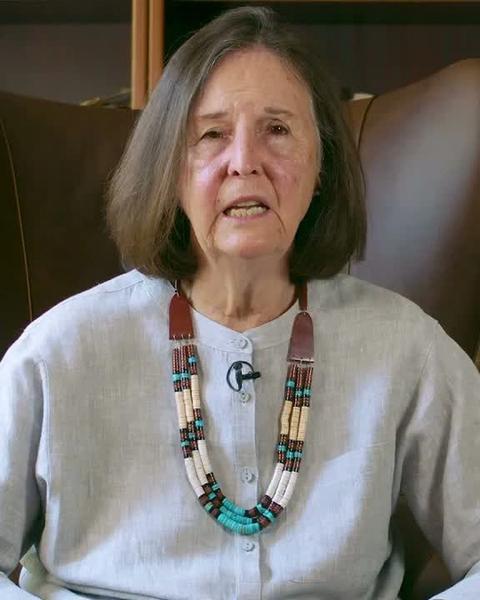
I unconsciously almost always fiddle with the small gold necklace that I wear to work every day. I never imagined that this little piece of jewelry would engender so many special moments, but it has.
At first, patients and families would say to me, “Dr. Boateng Evans, I like your necklace.” And I would say, “Thank you,” and just move on with my questions about their exam, characterize their pain or break news about their horrific injuries after a motor vehicle collision.
But one of the beautiful things about becoming more experienced as a doctor is that the more comfortable you become with the science of medicine, the more you can really flourish in the art of medicine. And exactly that happened.
Over time, in reading the room, I realized this necklace is more than just a piece of jewelry. This is an invitation. And so my thank-yous evolved from a sheepish, “Can I pray with you?” to, “What can I pray for you today?” as I became obedient to that still, small voice to gather hands or bow heads at the bedside.
My offers of prayer were not always met with a resounding yes. Let’s be clear about that, especially depending on which region of the country I was practicing in. But that was okay. I was comfortable with the no’s because working in the ICU is an immersion into the full range of humanity and the multitude of ways in which individuals meet their vulnerability.
It shows up as this gut-deep wail, a sound that seems to rip through time itself, when life moves in reverse and a parent has to eulogize their child.
Or the paralysis that strikes when a loved one walks into the ICU for the first time and they’re met by the whirring of the ventilator, the beeping alarms, the gallons of IV fluids and artificial nutrition being pumped into a vulnerable body, just trying to determine: Where do I land my fear?
Or the silence and the heaviness that follow after someone dies, and with guilt, patients’ families will ask, “Doctor, what do we do now?”
In no other space has my faith become more salient than walking patients and families through death and dying in the ICU.
However, faith, like medicine, is not always tidy. I have asked God why a thousand times. I’ve questioned suffering and His role in tragedy even more so.
But between uncertainty and surrender, this blur between grief and gratitude, this tension has taught me three key lessons about how we might better understand ourselves through our patients and the sacred work at the end of life that we all perform.
The first is that it will push us to places where categories collapse.
New York Times columnist Frank Bruni, who is also a professor of public policy at Duke, where I work, wrote a profound book last year, which maybe some of you are familiar with, called The Age of Grievance. In it, he describes how, as a culture, we’re becoming more and more defined by what outrages us and what angers us.
I’m sure Mr. Bruni did not have the ICU in mind when he wrote this book or think that it would be mentioned at a death conference. But surprisingly, I have found the book wildly applicable because, in the midst of grief, it’s very easy for grievance to take root against the unfairness of illness, against the failures of a healthcare system or even against the silence of God.
I can recall a young woman who died in our ICU recently, and when her youngest sister arrived at the bedside, she was seething. She was nearly foaming at the mouth.
She said, “I’m so angry. I’m so angry. I’m so angry.”
Her mom said, “At who, honey?”
She said, “I don’t know, but I’m so angry.”
And yet, even in that anger and yearning, there was still faith. When she settled, she scanned the room. Her eyes met mine. She focused in on my necklace.
I said, “Can I pray with you?”
And I was so honored when she said, “I would love that.”
I can think of numerous instances where categories dissolve. For example, there have been families of patients who have rushed into the ICU wearing Confederate flag T-shirts, and I, a Black physician, have been the one whose arm they have wept into, desperate for reassurance, desperate for medical expertise, desperate for mercy.
This truth, this blurring of categories, has met me again and again, but most memorably on a night shift a few weeks back.
The process started at sign-out. I heard the 50-second monologue from the day team, and I knew immediately: This patient will not survive the night.
He was estranged from his children, and so what I was most concerned about was that there would be no one with him while he died. I was one doctor caring for 22 patients in the ICU that night by myself. I had hands to keep him alive, but what I really needed most was a human touch so that he would not die alone.
So I did what all good ICU doctors do, and I paged the chaplain on call. Shout-out to all the chaplains.
Graciously, she arrived within what felt like minutes. What transpired next was one of the most beautiful evenings I’ve experienced.
We called his children on speakerphone and broke the bad news. There was certainly grief. There might have also been grievance. I wish I could have sat and unpacked and held the complexity of that pain, but instead, I asked about what his joys were, what his interests and hobbies were.
Over and over, in different iterations, they said, “Ministry.”
And so what transpired was a Jewish chaplain for a Christian pastor, our patient. She sang the lyrics to his favorite gospel songs. She recited Psalms, his favorite scripture, from memory. The two of us prayed the Lord’s Prayer for him in unison. Meanwhile, the nurse titrated his pain medications to keep him comfortable.
I came in and out of the room as I was able, sometimes just to hold his hand for a minute. I wish I could have sat with them longer, but the constant ding of my pager kept taking me away.
Finally, as this gentleman took his last breath, the chaplain was weeping for a man she’d never met.
I asked her at the end, “What do you think moved you so deeply?”
She said simply, “The humanity of it all.”
I’ll never forget that night.
This patient’s story shows us that the challenge is not necessarily to banish grievance, but to understand it as a shape or a proxy for grief, and thus to hold it alongside compassion so that our mourning does not close us in, but rather opens us up to connection with one another and to the mystery of what endures beyond this life.
That brings us to our second lesson, which is to leave room for your own miracle.
In medicine, there are few statements more polarizing than when patients and families come and say, “Doctor, we are waiting for a miracle.”
As physicians, we are trained in science and data and analysis and facts. And so when the word “miracle” enters the proverbial group chat, a lot of my colleagues are like, “Oh, I cannot compute.”
But what I hear when patients and families say, “We’re waiting for a miracle,” is simply, “We are holding on to hope.”
Miracle is the language of hope.
Sometimes the miracle is that medicine steadies the body long enough so that a son flying across the country can whisper goodbye to his dying parent. Or that there’s an unexpected lucid interval after days and weeks of immobility and silence, and a patient opens their eyes one final time to receive an “I love you.”
We don’t always understand why some patients die and others don’t. But these special moments, which happen in hospitals across the country and across the world every day, are sacraments of hope where faith meets science.
They’re a window into the small ceremonies that we all perform each day to maintain our humanity in the face of life’s dehumanization. They rewire us from traditional medical training that says faith and medicine are opposing forces, when in reality they’re often synergistic.
For my science people, stay with me.
There are several randomized controlled trials that have looked at the impact of prayer and spirituality on patients’ pain perception, ranging from postoperative recovery after C-section to electrical stimulation to major abdominal surgery. Across all of these domains, patients consistently report lower pain scores when faith practices are incorporated into their care plans.
That brings us to our third and final lesson, which is that maybe spirituality isn’t necessarily somewhere we go. Maybe it’s something we do again and again at the many altars of our modern life.
We all tend to think that spirituality belongs in pews and mosques and temples. But if you look closer, ritual is everywhere. You have all performed ritual today.
Some are small and quiet: the daily ritual of brewing coffee, the paced rhythm of a morning run, the tending of gardens or houseplants, or the playlists and songs that we all return to when words fall short.
We look to these rituals to fill our cup, to pour a certain fulfillment back into our spirit, in the same way that spiritual practices like a family gathering to keep Sabbath or break a Ramadan fast, an individual traveling to a silent meditation retreat or attending a wonderful conference like End Well are all seeking to be healed and transformed.
So whether you call it prayer or wellness, we’re all kneeling and showing quiet reverence to something. And at the end of life, those somethings reveal themselves in loud presence.
Ultimately, what I’ve learned after walking countless patients through death and dying in the ICU is that, in the hospital, even the most basic rituals that help us maintain our humanity are stripped away.
The scent of coffee is replaced by antiseptic. A favorite meal morphs into purée. Even the act of choosing one’s own clothes is surrendered at the door.
So in my ICU, we try to reimagine these rituals. I explain to families that during death, the sense of hearing is usually the last of the five to go. And so I encourage them to hold their patient, speak to their loved one, play comforting music, tell jokes, read scripture or sing songs that they enjoyed.
Over time, slowly, we hold vigil. Music becomes liturgy. Art becomes scripture. And the act of holding one’s hand becomes communion.
Truly, any room, if you allow it, can become a temple. Any gesture, if offered with love, can become a rite of passage.
At the end of life, whether at the bedside, at home or in the hospital, we are not just holding someone’s body. We are holding an altar.
In death, we will all face that same wilderness. In that wild space between divisions and grief and anger and categories, what will remain? What will sustain us is not certainty, but hope.
And hope is the greatest miracle of all.
Thank you.
RELATED