Your Grief Belongs at Work Too
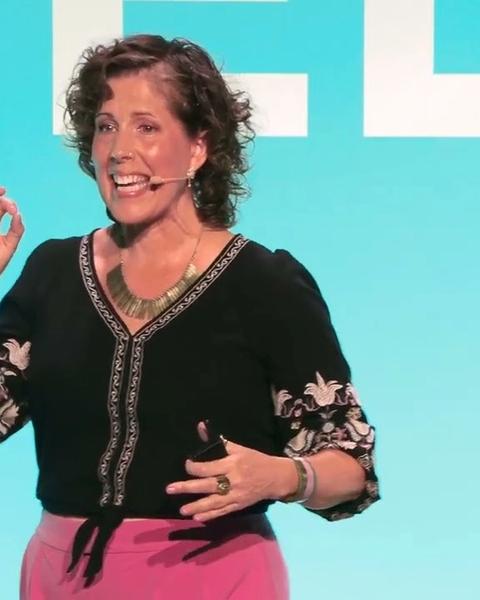
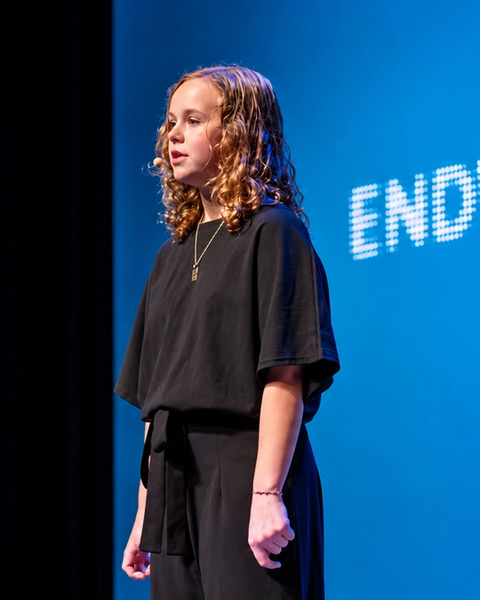
In this talk from End Well 2025, Rebecca Feinglos challenges the idea that grief is “unprofessional.” After losing her father suddenly while leading North Carolina’s pandemic response, she experienced firsthand what it means for loss to collide with work.
Most employees in the U.S. receive just three to five days of bereavement leave, if they receive any at all. Many take unpaid time. Many quit within a year. Rebecca makes the case that workplaces are already on the front lines of grief support. The question is whether they’re prepared for it.
A former senior policy advisor, Rebecca helped secure guaranteed bereavement leave for hundreds of thousands of North Carolina state employees. She is now the founder of Grieve Leave, a global community offering practical tools, resources, and even humor for intentional grieving. She also hosts the podcast Grief’d Up and has been featured in TIME, Fortune, the LA Times, and more.
Grief does not clock out when we clock in. What would it look like to build workplaces that acknowledge that reality?

November 20, 2025
Transcript
What I’m about to tell you isn’t safe for work. At least, that’s what we’re supposed to believe.
I’m going to talk about grief.
We’re taught that grief is too personal for work. It’s unprofessional, too messy for our Slack channels and our small talk. So, if you’re watching this while you’re on the clock, I wonder if you’ve already turned the volume way down. Or maybe you’re ready to minimize the tab if your manager walks in.
The truth is, grief is already at work. It doesn’t clock out when we clock in. It doesn’t care about your Outlook calendar. I know that because I’ve lived it. And if you haven’t yet, you probably will.
It was a Saturday morning, March 14, 2020, when my boss called me. She said, “We need you to come into Raleigh to help us announce that we are shutting down schools across North Carolina.”
I was a senior policy adviser for the state Department of Health and Human Services. I remember thinking in that exact moment, what do you wear to a pandemic press conference?
I went with a blazer and wide-leg pants.
Somewhere on my drive over on Interstate 40, I called my dad, the person I always called when I needed grounding. My dad told me he was proud of me. He was a little short of breath, but he brushed it off. At the end, we said, “I love you,” like always.
Two hours later, I was in a basement conference room leading a crisis response team when a colleague tapped me on the shoulder. He said my phone had been going off in my bag.
I paused and checked my missed calls. My mother had died when I was a child. My dad got married again about 10 years later. This was his wife calling me over and over and over again. So I stepped out into the empty hallway to call her back.
She answered and said, “I am so sorry to tell you this, but your daddy is dead.”
I collapsed.
If you’ve ever gotten news like that, you know exactly what that collapse is like. Your body just stops holding you up.
My family would later learn that two blood clots, one in each lung, had been slowly making their way through my dad’s body before very suddenly killing him. But we didn’t know any of that yet.
A colleague of mine found me in the hallway. His name was Mark, the same as my dad’s, because of course.
Mark thought I was injured. I somehow managed to croak out, “My dad’s dead.” My eyes, I know, were full of disbelief at what I had just said.
Mark ran to get help. I was still lying on the floor with my phone held up to my ear, and I could hear my dad’s wife, now a widow, saying, “Talk to me. Where are you right now?”
I was speechless, just sobbing into the gray office carpet.
“Is anyone with you?” I heard her say.
Then I felt multiple sets of hands help me sit up in the hallway. Around me were my boss, my boss’s boss, and a bunch of other people who probably had to step out of a meeting with the governor to help pick me up off the floor.
Here we were in the middle of this global crisis, and mine had taken center stage for just a moment.
My colleagues grabbed my things from the meeting I had been leading, a meeting that had to keep going, led by somebody else. They told me they would drive me wherever I needed to go.
A few hours later, I tuned in live for the governor’s lockdown announcement while sitting on the couch of my childhood home. My blazer was balled up next to me, my pants impressively wrinkle-free.
That was sometime after my dad’s body had been taken out in a blue nylon bag.
My team was incredibly supportive over the next few weeks, urging me to stay home for much longer than I wanted to. I was burning through vacation days because I learned that state employees in North Carolina had no protected bereavement leave. None.
Eventually, I decided to do what I had always done in the face of grief: stay busy and ignore it.
Does that sound familiar to anyone else in this room? Probably not in this room. You all probably face your grief.
I mentioned earlier that my mother died when I was a child, and it is deeply meaningful to me that today is Childhood Grief Awareness Day. The message I got as a child was that productivity was the best disguise.
As my mom was dying of brain cancer, I used school as a mask. I showed up every day with French-braided hair, so many friends, achieving everything. No one would have guessed that I had a dead mom. And I relished the act.
Two decades later, I put on some lipstick and some blue-light glasses that were probably pointless, and I got back to work, hoping to escape my grief.
But my grief came to work with me. It was the office mate I didn’t want.
Productivity was not as much of a disguise this time around. All of my colleagues were aware of my traumatic loss, and so many of them had literally seen me at the worst moment of my entire life. The veil between personal and professional was ripped wide open.
A few months after I came back to work, someone who had helped pick me up off the floor on that awful day said something like, “I keep forgetting how fragile you still are.”
That was how I felt at the time. She said I was more sensitive now, more emotional.
I was devastated.
No matter how hard I was working, I was trying to show up professionally. I was trying to get things done, and I was still left feeling vulnerable and exposed.
In retrospect, I think my colleagues felt vulnerable and exposed too, because all of us were coming face to face with my grief at work, the thing we’re all taught is not supposed to happen.
Let’s take a step back from my story for a second, because although it may sound tragic to some of you, it is actually not that unique.
The majority of employees in the United States get about three to five days of bereavement leave, if they get any at all. About 70 percent of people end up taking more time than that, often unpaid.
Four in 10 employers intentionally check in again with a grieving employee after the funeral. Half of employees who are grieving quit within a year of their loss. I made it to a year and a half, but I quit too.
Globally, grief, anxiety, and depression contribute to 12 billion lost workdays and $1 trillion in productivity losses worldwide.
We have the data. We have the stories. Altogether, they are telling us the same thing: our workplaces are the front lines of grief support in America, and they’re not ready for it.
Think about it. If someone you love dies right now, who is probably the second person you will call with the bad news, after your spouse or your sibling?
It’s probably your boss.
Your boss is second in line for a phone call at the worst moment of your life. Is your boss ready to take that call? If you manage a team, are you ready to take that call?
We all want the answer to be yes. But we are up against the mentality that grief is unprofessional to talk about at work. When it inevitably gets there, we’re unprepared.
Grief is already at work. So what can we do to make it feel safer?
Policy change is part of the solution. When I learned that state employees in North Carolina had no bereavement leave, I worked for years with lawmakers to change that.
Today, I am so proud to tell you that hundreds of thousands of employees in North Carolina have guaranteed, paid, protected bereavement leave.
That means someone in my exact position, having the worst day of their life, would not have to burn through vacation and sick days like I did. That is a big deal.
But policy change is not the full story.
Grief doesn’t just need paid leave. It needs leadership. It needs culture change. It needs all of us.
I want you to imagine two different workplaces and an employee named Mark. Yes, we’re still going with Mark, named after my late father.
Mark’s mother dies suddenly, and he calls his boss at Workplace A. His boss says, “I’m so sorry for your loss. Please take all the time you need.”
But Mark finds out that this actually means he gets two days off to go to the funeral. He has to submit an obituary to HR to prove that his mother’s death is real.
He comes back to work after those couple of days, and there is a sympathy card with some doves on the front, signed by his team. No one ever mentions the card out loud or talks to him about his loss again.
Mark’s boss keeps him off new projects for months to avoid overwhelming him, but no one ever asks Mark what he wants to do.
Mark ends up quitting Workplace A within a year.
Now let’s imagine Workplace B.
Mark calls his boss. His boss says, “I’m so sorry about your mother. What was her name?”
Mark gets a week of paid leave right then, along with a few days of flexible leave that he can use whenever he wants during the next year.
A group of Mark’s colleagues, called the Caring Committee, regularly checks in on him when he gets back to work. They leave snacks on his desk. Sometimes they invite him to lunch.
Mark feels comfortable talking to his boss about his workload and how it can shift over the next few months.
Mark uses one of those flexible bereavement days on his late mother’s birthday, when he didn’t expect the grief to hit him and it did.
A year after his mother’s death, on the first anniversary, the Caring Committee sends Mark an email to say they’re thinking of him.
At Workplace B, Mark stays for years. He felt held by his colleagues in his immediate time of need and for long afterward. Mark loves working at Workplace B.
We don’t have to imagine a workplace like this, y’all. I am from North Carolina. I can say y’all.
We can build a workplace like this right now.
Here’s my challenge to all of us.
If you’re a CEO, part of your job is to model humanity in our toughest moments. You need to build bereavement policies that actually reflect how long grief lasts. Train managers to listen instead of trying to fix something that really can’t be fixed.
If you’re a manager, maybe those conversations you’re avoiding are some of the most important ones for you to have. Invite the grieving employee into conversations about their workload. Make those decisions together. Don’t make assumptions.
If you’re a colleague of a grieving employee, keep showing up after the sympathy card. Your presence matters.
And if you are the grieving employee coming back to work, please hear me when I say this: you do not have to hide your grief to make everyone else at your workplace feel more comfortable. It perpetuates an impossible standard.
Your grief belongs at work too, because it has to. It has nowhere else to go.
When we create workplaces that are more sustainable for grieving people, we create better workplaces for everybody.
I got to practice what I preach this year.
For the first time, someone I manage lost a loved one. She works at the small company I founded three years ago, and she is here today, so I’m feeling emotional about it.
It surprised me when she wanted to come back to work. I felt uncomfortable and thought she was coming back too soon.
I had to face my own discomfort and remember that if she wanted to come back to work, then her grief would come to work with her. My actions, my words, my emails, and our work together would all be part of her grief support system.
Our small team figured out how to hold it all alongside her, and we are still holding it now.
Grief isn’t something you step in and out of. It’s part of the air you breathe, the work you do, and the people you hold and who hold you.
When my dad died, my colleagues literally lifted me off the floor with their hands. What I want now for all of us is for those hands not to vanish after the first days back at work.
Let’s stop pretending that grief isn’t safe for work. Grief is already here, and it deserves to be met with open hands.
Thank you all so much
RELATED