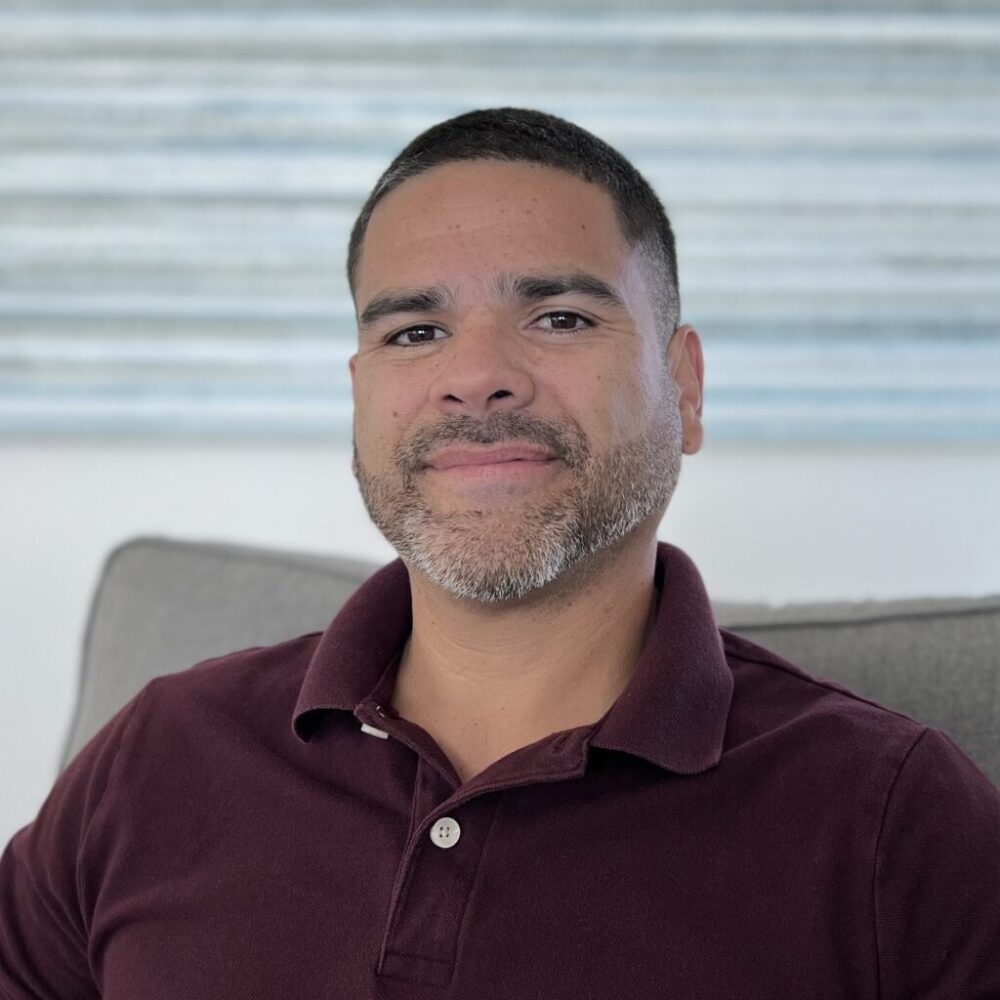
What prison hospice can teach everyone about compassion. And, how accepting a compliment, naming our shared humanity, and “training your replacement” become acts of radical bravery. A conversation with Fernando Murillo.
By End Well
In a warm, funny, and deeply human conversation, End Well’s Tracy Wheeler and Molly Rosenfeld talk with Prison Hospice advocate and mentor Fernando Murillo about: learning to accept compliments, building human-centered practices across the carceral system, mentoring through a “train your replacement” ethos, and visualizing change—what he once called living inside a “simulator.” Together, we explore our 2025 theme of Radical Bravery, especially the idea of grieving the lives we didn’t lead and how that grief can move us toward connection, care, and resilience.
The moment that starts with “thank you”
We begin, unexpectedly, with compliments. Fernando laughs about how hard it can be to receive one—how the inner critic pipes up before the gratitude does. When he was incarcerated, he used to talk with younger people inside prison about practicing this exact skill: accept the compliment. Say thank you. Notice what rises up. Don’t swat it away.
“It’s hard to accept compliments. Criticism kicks off an internal monologue; we rarely practice the other end of the spectrum.”
It’s a small moment with big implications. In serious illness, caregiving, and grief, we often default to fixing, minimizing, or deflecting. Fernando’s invitation is simpler: let care land.
From Level 4 to leadership: “Train your replacement”
Inside high-security institutions, Fernando became a leader—not by title, but by practice. He shifted his life toward discipline, education, and service, and younger people began to ask, “OG, what do you do every day?” Out of that came mentoring and a youth diversion effort called Understanding, Nurturing, and Inspiring Youth.
“Train your replacement” became a guiding philosophy.
The idea is disarmingly practical: if your goal is re-entry and contribution, start now by lifting others. Invite them to shadow, learn, and imagine a different ecosystem—one that mirrors the community you hope to join. It’s radical not because it’s loud, but because it is repeatable.
Humanizing across uniforms
Fernando describes the anonymity that saturates carceral life—for incarcerated people and for correctional staff who go home to communities that don’t understand what they do. He began a quiet practice of humanizing:
- Use names.
- Ask, “How would you like to be addressed?”
- Be politely consistent, no matter the role or uniform.
“Taking the initiative to humanize folks was powerful, and it went a long way.”
For end-of-life contexts, this is a mirror: patients, clinicians, family members, aides—everyone benefits when we slow down to see the person in front of us.
The lives we didn’t lead
Tracy names a theme that will shape Fernando’s End Well talk: grieving the lives we didn’t lead. That phrase lands softly and then opens wide. We all hold alternate timelines: paths we couldn’t take, versions of ourselves we had to set down. Grieving those unlived lives can make space for self-advocacy, for accepting care, and for connecting honestly with others—especially when serious illness, caregiving, or loss brings competing identities into sharp focus.
This aligns with our End Well 2025 Radical Bravery framework:
- Courage to See: examine the stories we’ve carried.
- Courage to Connect: build honest, human relationships.
- Courage to Care: show up for ourselves and others.
- Courage to Carry On: sustain purpose and resilience over time.
Fernando’s story sits right at this intersection.
The simulator: visualizing change
Spending years in a cell, Fernando developed what he calls a simulator—a disciplined practice of visualizing how he wanted to show up in life. He still uses it. As he prepares to speak at End Well at the Skirball Cultural Center, he mentally “walks the room,” imagines the audience, and rehearses the feeling of a conversation, not a performance.
“I’m placing myself in the space and seeing how it feels to present—there’s magic in that.”
A recovering know-it-all’s don’t-know mindset
As an educator and facilitator, Fernando jokes that he’s a “recovering know-it-all” who now tries to approach each moment with a don’t-know mindset. That stance—curious, humble, open—helps him learn from every person and every subject. It’s also how we hope to meet each other at the end of life: not with all the answers, but with room for truth.
Four practices you can try today
Inspired by the conversation, here are simple, evidence-adjacent practices you can apply in care, grief, or everyday life:
- Compliment receiving
When someone offers praise, pause. Breathe. Say “Thank you.” Notice any urge to deflect; let the care land. - Name and ask
Address people by name. Ask, “How would you like me to address you?” Small respect, big impact. - Train your replacement
Whatever you know, teach it. Invite someone to shadow you. Build the ecosystem you wish existed. - Use the “simulator”
Before a hard conversation or appointment, visualize how you want to show up—tone, posture, first sentence.
How Fernando builds a talk (and a community)
Fernando is thoughtfully shaping his End Well talk using a simple structure: invite people into a place, help them see themselves there, and leave them with actionable takeaways they can carry into their own communities. It’s less about performance, more about practice—exactly the kind of generosity we try to model at End Well.
“I want people to see how they can make a difference with their time, energy, thoughts, and effort.”
What’s next
Fernando will join us on the End Well stage on November 20. He’s also authoring a short contribution to our Radical Bravery Companion Guide, likely under Courage to Care—the deep work of learning to care for yourself so you can genuinely care for others.
If you’re navigating illness, caregiving, or grief, a clinician or anyone looking for human-centered approaches to end of life, we hope you’ll join us—in person or virtually.