How We Choose End Well Speakers: Radical Bravery and the Art of Being Human


November 12, 2025
Every year, as we prepare for the next End Well gathering, I’m asked some version of the same question:
“How do you choose your speakers?”
It’s a great question. The people who take our stage aren’t chosen because they’re the most famous, the most credentialed, or even the most eloquent. We choose them because, in some essential way, they’ve met life where it hurts and still found something beautiful to offer back.
That’s the real through-line of our curatorial process, what I sometimes call the End Well alchemy. It’s not about expertise alone. It’s about the courage to tell the truth and the generosity to make that truth useful to others.
We Don’t Look for Perfection. We Look for Presence.
Some of our speakers are world-class clinicians. Others are caregivers, actors, pastors, or patients. Some are all of the above.
What matters most isn’t the résumé. It’s the willingness to show up fully human, a little cracked open, and ready to connect.
When I first talk with a potential speaker, I listen for a few things:
- Do they tell the whole story, even when it’s messy?
- Do they see the connection between their story and someone else’s?
- Do they have a kind of generosity that makes hard things easier to hear?
If the answer to those is yes, I know they belong on the End Well stage.
We Build a Program Like a Conversation, Not a Conference.
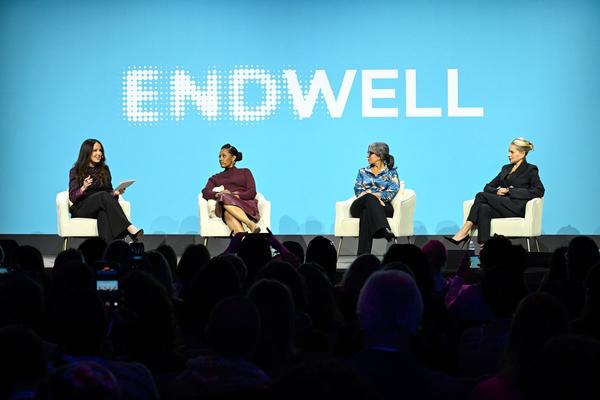
End Well isn’t designed as a lineup of isolated talks. It’s a living dialogue. Each voice is chosen to speak to the others, not after them.
A philosopher might open the door for a scientist. A pastor’s story might echo in a physician’s data. An artist’s performance might make the research land differently in your chest.
That’s how culture changes, through stories that collide, overlap, and soften us.
We Start With the Question, Not the Answer.
This year’s theme, Radical Bravery, didn’t start as a slogan. It started as a question we couldn’t shake:
What does courage look like when things don’t get better?
Every session, every workshop, every story on that stage is a facet of that question.
Radical bravery isn’t about fearlessness. It’s about staying present when the grief is fresh, the system is broken, the news is bad, and showing up anyway.
That might look like:
- A clinician who chooses empathy over efficiency
- A caregiver who keeps loving through exhaustion
- A patient who teaches us how to live while dying
- A leader who uses their privilege to build bridges instead of walls
We Choose People Who Change Us.
When I look back at the hundreds of people who’ve shared their stories since 2017, one thing is true every time: I leave changed.
Each of them, in their own way, helps us remember that being human isn’t about having answers. It’s about staying open, even when it hurts.
These are the teachers I didn’t know I needed.
And when I look out into the audience, at clinicians, creators, caregivers, and people just trying to live honestly, I realize they’re teachers too.
What We’re Really Trying to Do
If there’s one thing I hope people understand, it’s this: End Well isn’t just an event. It’s an act of cultural repair.
We’ve become so afraid of the end of life that we either medicalize it or ignore it. But every year, when people come together and start talking honestly about loss, love, and meaning, something shifts.
You can feel it in the room when the walls between fear and connection dissolve.
That’s why we do this work. That’s why I keep doing this work.
Because when we face death, we reclaim life.
Because courage grows in community.
Because, as one of our speakers said:
“We’re all standing in the bus lane. Empathy is how we meet each other there.”